

For venue and estate owners, how you run catering shapes your revenue, your reputation and your workload more than almost any other decision. An honest look at the four models, and what each one really asks of you.
Most venues do not choose a catering model so much as inherit one. A barn opens on a dry-hire basis because there is no kitchen yet. An estate builds a list of approved caterers one recommendation at a time. A country house takes catering in-house because a talented chef happened to be available. Years later, the arrangement is still in place, whether or not it still fits the business.
It deserves a deliberate decision. Food and drink is usually the part of an event guests remember and talk about most. It can be a significant source of revenue, and it carries more operational and legal risk than anything else that happens on site.
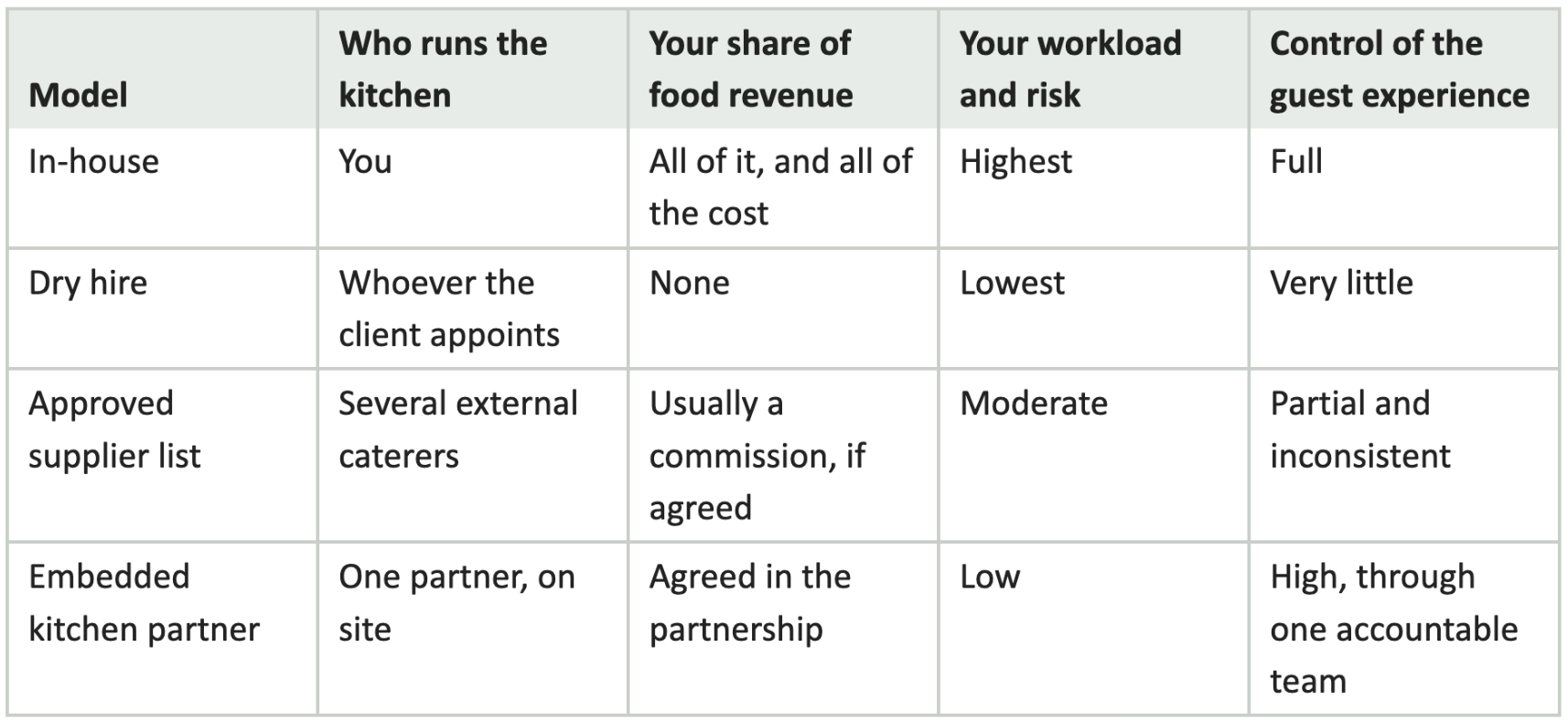
The four models at a glance
In-house catering: full control, full weight
Running your own kitchen gives you complete control of the menu, the service and the margin. It also makes you a restaurant business as well as a venue. You recruit and keep chefs in a notoriously difficult labour market. You own food safety, allergen compliance, supplier relationships, equipment and the cost of every wasted portion. When a head chef leaves, the standard can leave with them.
In-house works best for venues with enough year-round volume to keep a strong team fully employed, and leaders who want to run a food business. For venues with a seasonal calendar, the fixed cost of a permanent kitchen team can outweigh the margin it earns.
Dry hire: simple, and growing, but you give a great deal away
On a dry-hire basis, the venue provides the space and the client brings everything else, including the caterer. It is operationally light, and demand is real: Bridebook reports that searches for dry-hire venues on its platform reached 2,000 in June 2026, up 188% year on year.
The cost is less visible. You earn nothing from food and drink, one of the largest parts of most event budgets. You also hand your guests' experience, and your kitchen, to caterers you did not choose and may never see again. One poor meal is usually remembered as a poor venue, not a poor caterer.
Approved supplier lists: the compromise most venues make
A list of approved or preferred caterers keeps clients' choice while giving the venue some say over quality. It can also be commercially valuable. Bridebook's 2026 data found that couples at venues requiring a caterer from a set list spent an average of £159 per head on catering, compared with £114.45 for in-house catering and £112.50 where couples chose freely. Venues with required lists tend to sit at the premium end of the market, so this is not proof that a list raises spend. It does show that clients at those venues accept a higher spend per head.
The weakness is consistency. Several caterers means several standards, several ways of leaving the kitchen and several teams your staff must brief. Your reputation rests on businesses whose day-to-day standards you cannot see.
The embedded kitchen partner: one team, one standard
The fourth model is the one The Kitchen & Co Collective was built around. An embedded partner takes full operational and culinary responsibility for the venue's kitchen: staffing and recruitment, procurement and supplier relationships, menu development, service standards, compliance, and health and safety. The partner is not a supplier the venue manages. It is the team running the kitchen as if it were its own.
For the venue, three things change:
One point of accountability. One team, one standard and one relationship replace a rotating cast of external caterers.
Consistency that does not depend on individuals. The kitchen performs the same way in its hundredth week as in its first, because the systems behind it do not depend on any one person being in the building.
Time back. The venue's own team can focus on its guests, its grounds and its reputation.
This is the model behind every Kitchen & Co kitchen, including Primrose Hill Farm, our longest-standing partnership, as well as Caswell Kitchen, Moxhull Hall and The Little Kitchen in Farnborough. Every partnership looks a little different, because every venue does.
How to choose: five questions for venue owners
How much of the year is your venue busy? Year-round volume can support an in-house team. A seasonal calendar usually cannot.
What is food and drink worth to your business today? Include the revenue you are not earning, not just the revenue you are.
Who carries the risk when something goes wrong? Think about allergens, food safety, late cancellations and staff sickness.
How consistent is the experience across your events now? Your reviews will usually tell you.
What would your team do with the time back? For many venues, sales and guest experience are the real opportunity.
Questions to ask any prospective catering partner
Before you appoint anyone to run your kitchen, ask to see a kitchen they already run and speak to the venue behind it. Ask who will be on site week to week, how menus are developed with you, and how quality and guest feedback are reported. Ask how the commercial arrangement works and when it is reviewed. If you currently employ kitchen staff, ask how the transition would affect them, and take advice: TUPE regulations can apply when a service moves from one employer to another.
Frequently asked questions
What is the difference between an exclusive caterer and an approved supplier list? An exclusive caterer is the only caterer permitted at the venue. An approved supplier list allows clients to choose from several caterers the venue has vetted. An embedded kitchen partner goes further than an exclusive caterer, taking responsibility for running the venue's kitchen as well as catering its events.
Do venues earn commission from approved caterers? Many do, although terms vary widely and are agreed privately between venue and caterer. What matters most is that the arrangement is clear, measurable and reviewed regularly.
What does an embedded kitchen partnership include? With The Kitchen & Co Collective, it covers staffing and recruitment, procurement and supplier relationships, menu development, service standards, compliance, and health and safety: the full operational load of running a professional kitchen.
Can I see a partnership kitchen before deciding? Yes. Seeing the model in action is the best way to understand what a partnership looks like day to day.
Thinking about what this could look like at your venue?
If you run a venue, an estate or a hospitality business and want a partner who will treat your space and your guests with the same care you do, we would be glad to talk it through. Explore a partnership